Showing posts with label Trading Forex. Show all posts

Thursday, January 27, 2011

Forget inflation-Ireland seeking external debt advice help EUR?

India has hiked, New Zealand stands pat, Trichet talks tough, Bernanke hangs loose and Gillard is flood taxing, which is another form of tightening. Inflation is on everyone lips, we are either denying it, embracing it, but the world is definitely talking more about it. UK is a mess. They currently have GDP issues with inflation overtones, an austerity plan running amuck has consumers becoming less confident about their prospects, suggesting that their economy will not be receiving help from household spending soon. A dovish Governor Carney worried about the strength of his loonie, a currency that the world wants to own a piece of. Rates are not an issue with the BOJ, its their credit rating. S&P’s has stepped in this morning and downgraded the country’s credit. As a result, investors will be expected to unwind some of their recent acquired risk. Hawkish comments by Bini Smaghi, highlighting the importance of headline inflation as opposed to the core inflation, has put the squeeze on the weak EUR shorts this morning. Keep an eye on Ireland, its believed they are seeking external advice on how to restructure their debt. A delegation is supposedly contacting Felix Rohatyn, the architect of NY’s debt restructuring in the ‘70’s.

The US$ is stronger the O/N trading session. Currently, it is higher against 13 of the 16 most actively traded currencies in a ‘volatile’ O/N session.

Forex heatmap

Yesterday’s new US home sales blew past expectations. It increased by +17.5%, rising to a seasonally adjusted +329k vs. market expectations of +299k (+3.1%) in December. Digging deeper, the median sales price last month was $241.5k, up +8.5% year-over-year, while sales were down -7.6% for the same month in 2009. The same excuse’s that apply to this week’s S&P/Case-Shiller house price index are also providing pressure on new home sales. High unemployment in the US coupled with elevated foreclosures continues to depress the market and their values. This is strong proof that we are probably in ‘that double-dip’. Sales for a period last year surged on the back of a federal home-buyer tax credit. The programs expiration has only added to the US housing woes. Lower prices provide affordability, but with prices remaining in a downward spiral, no one benefits. What’s potentially more frightening is the size of the ‘shadow inventory’ that remains on the sidelines. New home sales are notoriously volatile and subject to large revisions, particularly at this time of year.

OK, to the meat of yesterday. There were no surprises by the Fed’s decision to keep rates unchanged. The extended period remains in play. No change to QE2 and its ‘promised’ end date. I though helicopter Ben’s aim was to get long yields down? No one dissented. No real change to their economic assessment, OK, maybe a tad more optimistic with policy makers noting that ‘growth in household consumption picked up’. They admit that the recovery is continuing, but as expected, suggest this is insufficient to cause a significant improvement in the labour market. Is employment not a lagging indicator? Have the private sector not added +1.3m jobs to their payroll last year? In reality, the high unemployment rate is a factor of the ‘magnitude of jobs lost in the recession’. The labour market needs time. On prices, the Fed noted the increase in commodity pries but said that inflation expectations remain stable and that underlying inflation has been trending. In other words, the Fed is reluctant to rock anybody’s boat just yet.

The USD$ is lower against the EUR +0.01% and higher against GBP -20%, CHF -0.34% and JPY -0.77%. The commodity currencies are weaker this morning, CAD -0.34% and AUD -0.72%. ‘Much ado about noting’ had the loonie again trading in a tight range despite a rally in equities and commodities. The loonie did find some buying interest after the Fed kept their stimulus measures in place, as investors sought some higher-yielding assets. With the Fed maintaining its plan to buying treasuries can only be an advantage for the currency as investors become more comfortable with risk assets and this despite softer than expected December inflation data earlier this week reinforcing expectations that the BOC will move cautiously on rising interest rates. Higher energy prices (+13%) and some base-year effects were behind the pickup in headline inflation in December (+2.4%). Disinflationary pressures from excess capacity are expected to continue to restrain core-inflation (-0.3%). Governor Carney said last week that the Canadian economy has ‘considerable slack’ that will keep core inflation below +2% until the end of next year. But, with the pick up in global appetite for risk, speculators will now be looking for better levels to sell the dollar (0.9951).

The AUD has traded under pressure in the O/N session, ever since Prime Minister Gillard announced a one-off tax from 1 July 2011 to fund post-floods reconstruction. The market has seemingly interpreted this as a form of fiscal tightening which eases the pressure for RBA to tighten monetary policy. Dealers have promptly lowered their bets on an increases to the benchmark interest rate over the next year. Pricing over the next 12-months fell-7bp to +22bp after this morning’s announcement.Weaker inflation and the devastation caused by floods will very likely delay further RBA hikes beyond the first quarter. Last weeks data out of its largest trading partner, China, has the market convinced that the PBOC will move to hike their reserve rates. Their actions will reduce further the demand for the commodity sensitive growth currency. The credit downgrade by S&P’s of Japan is also capable of taking some ‘risk’ off the table. Offers again appear at parity (0.9918).

Crude is lower in the O/N session ($86.60 -73c). Yesterday, crude rebounded from its two-month lows on speculation that Chinese demand this year boosted bets that the commodity’s slump was exaggerated. The gains were capped after the weekly EIA report revealed that inventories ballooned. Weekly stocks climbed +4.84m barrels to +340.6m vs. expectations of a +1.2m barrels rise. Not to be out done, gas supplies increased +2.4m barrels, against expectations of a +2.1m. The only negativity came with distillate supplies (heating oil and diesel) decreasing-100k, less than the expected-300k. Refinery’s in puts averaged +14.1m barrels per day, which was-212k barrels below the previous week’s average as refineries operated at +81.8% capacity. Weekly imports averaged +9.4m barrels per day, up by +386k barrels. Over the last four-weeks, imports have averaged +8.9m barrels, a +517k barrels per day above the same four-week period last year. Earlier this week the Saudi Oil Minister indicated that OPEC may increase production levels to meet increasing global fuel demand. His comments have certainly put a medium term cap on the black stuff. He indicated that global demand was expected to increase around +2% this year. OPEC believes that supply and demand are ‘in balance’. Fundamentally, there is far more oil in storage, more fuel capacity and more idle oil wells to limit a stronger market rally in the medium term. Technically, an $85 barrel remains on the horizon.

Gold prices have not gravitated far from this weeks three-month low as equities rally, eroding further demand for the metal as a haven. With increased risk appetite in the market, investors are shying away from the commodity seeking ‘price appreciation’. Currently, the market does not expect gold to outperform other asset classes. With global confidence growing, one gets the feeling that the bulls are trapped and will soon be pushing that panic sell button. Fundamentally and technically the trend has turned rather badly against the longs. Month-to-date, the commodity has fallen -6.3% and only weeks after recording a +30% annual return. Buying has been less than modest with the commodity off to its worst start in 14-years. Has the gold peaked or is simply a short-term correction? The metal has shred $100 from its December highs. With the Euro-zone being able to sell their bonds, there’s less of a flight to quality, which could cause this asset class to be staring at a sub $1,300 a once soon. The market remains a seller on up ticks ($1,340+$5.60).

The Nikkei closed at 10,478 up+77. The DAX index in Europe was at 7,152 up+25; the FTSE (UK) currently is 5,980 up+12. The early call for the open of key US indices is higher. The US 10-year backed up 8bp yesterday (3.41%) and is little changed in the O/N session. Stronger US housing data coupled with increased global optimism had the US curve backing up ahead of the difficult $35b five-year auction and the FOMC statement. The auction came in very strong. The notes were issued at 2.041% vs. 2.149 last month. The bid-to-cover was 2.97 compared to 2.76 from the four auction average. Indirect bidders (institutions and Cbanks) took 45% vs. the 39.2% four-auction average. Direct bidders (money managers and hedge funds) took down 10% after taking 6.2% last month. Since the FOMC statement yesterday, it seems that some investors are not buying into the laissez-faire Fed inflation approach and are pressurizing the long end of the curve. This obviously suits banks, borrow short and lend long. Today we get the last of this weeks $99b auctions, the $29b 7’s.


Powered By WizardRSS

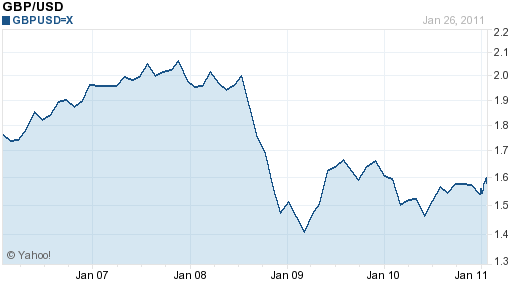
British Pound Faces Contradictory 2011

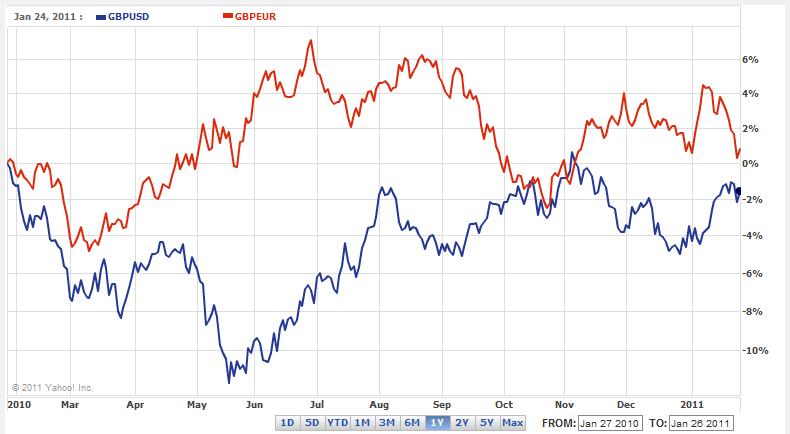
The last few years have been volatile for the British Pound. In 2007, it touched a 26-year high against the US Dollar, before falling to a 24-year low a little more than one year later. During the throes of the credit crisis, analysts predicted that it would drop all the way to parity. Alas, it has since managed to claw back a substantial portion of its losses, and finished 2010 close to where it started.

At the moment, however, there are two contradictory forces tugging at the Pound, which could send up upwards against the Euro but lower against the US Dollar. The first is the sovereign debt crisis in the EU, which flared up dramatically in 2010 and currently threatens to crippled the Euro. I will offer more commentary on this issue in a later post; for now, I just want to point out its role in supporting the Pound. While the Dollar is the Euro’s chief rival, many traders have turned to the Pound (and the Swiss Franc) because of their regional proximity. “As long as the euro-zone debt crisis is in the focus of the market, it will be the main driver of euro-pound,” summarized one strategist.

The second force (or set of forces) is propelling the Pound in the opposite direction. Basically, the UK economy remains depressed. Thanks to an unexpected contraction in the fourth quarter, GDP growth in 2010 was an exceptionally modest 1.7%. This was hardly enough to compensate for the average annual growth of .1%/year from 2006 to 2009, and send the Pound tumbling. Forecasts for 2011 and 2012 have since been revised downward to about 2%.

In order to spur Britain’s export sector, the Bank of England has deliberately acted to hold down the Pound, which it has managed to achieve through a combination of quantitative easing and low interest rates. “For a long time that’s what we were targeting, and we managed to get it down by about 25 percent â€" the exchange rate, that’s had a huge benefit to the U.K. economy,” a former member of the monetary policy committee recently admitted.


An unintended byproduct of this policy has been price inflation. At 3.75%, the inflation rate is among the highest in the industrialized world, and certainly the highest among G4 currencies. At the very least, the Bank of England will have to suspend any aspirations to match the Fed in printing more currency and expanding its QE program. It will probably also have no choice but to raise interest rates, which it might otherwise not have done until the economy is on more solid footing. The markets are currently projecting an initial rate hike of 25 basis points in the third quarter, and for the benchmark rate to exceed 1.5% by the end of the year, compared to .5% currently.

It’s difficult to say how the currency markets will make sense of this. Given that real interest rates will remain negative (due to inflation), it seems unlikely that any yield-seeking investors will suddenly start targeting the British Pound. In addition, given that the risk of ‘stagflation’ in the UK is now real and that the government is set to assume a record amount of new debt over the next few years, risk-averse investors will probably stay away. According to the latest Commitment of Traders report, speculators are already starting to establish bearish positions against the US Dollar.

While the Pound looks vulnerable, the big unknown is ultimately the EU fiscal crisis. If one of the peripheral members leaves the Euro, as some commentators predict will finally happen, then all bets (for the Pound, etc.) are off.

SocialTwist Tell-a-Friend

Powered By WizardRSS

DC To Davos!

« Has The Ball Started Rolling? | Home

By Mike Conlon | January 26, 2011

Last night the politicians were out in full force as were the financial elite in Davos in what has become nothing more than self-aggrandizement exercise whereby we are supposed to feel confident that our economic problems will be solved among platitudes and champagne! Color me unimpressed.The State of the Union speech came and went last night with no appreciable clarity that would inspire confidence that the US government is prepared to “get real”. While the business climate here in the US has improved, we still have a LONG way to go to reduce that 9.4% unemployment rate which continues to drag on the economy.

Later this afternoon, the FOMC rate decision is expected and while no change to policy is expected, listen to the economic forecast to see what they are basing their projections on.

Across the pond, the BOE minutes revealed that indeed another policy-maker has blinked, as the thought of that higher CPI data has caused another to join the push for a rate hike. This has sent the Pound higher this morning, but it must be noted that the awful GDP number reported yesterday was not factored into the dissent, so I don’t see how it is possible to raise rates when contracting GDP figures point to a double-dip recession.

Later tonight, we will get the RBNZ rate decision from New Zealand where no change is expected, but pay close attention to whether or not the comments appear to be hawkish or dovish.

So today is a bit of a mixed bag, with stocks and commodities initially higher to start the morning.

In the forex market:

Aussie (AUD): The Aussie is mixed as investors can make neither heads nor tails of all of the jabber surrounding the markets. There’s no additional economic data due out this week, so expect the Aussie to trade on risk themes.

Kiwi (NZD): The Kiwi is lower across the board to start the day ahead of tonight’s rate policy decision. While there expected to be no change, a change in sentiment could produce big moves in either direction though I am inclined to say that the Kiwi should go down on dovish rhetoric. (Click chart to enlarge)

nzdusd0126.JPG

Loonie (CAD): The Loonie is mixed to start the day, catching a bid from higher oil prices and the expectation that the FOMC meeting may forecast stronger US economic growth which would benefit Canadian exports.

Euro (EUR): The Euro is mostly trading flat to lower as all eyes are focused on the shindig at Davos. There is no significant news for the Euro zone today, though German import price index did increase more than expected.

Pound (GBP): The Pound is higher across the board as another dissenter joined in the call for an interest rate increase. However, it must be noted that this is unlikely to be the case after the negative GDP number reported yesterday BEFORE austerity measures actually kick in. So this may be a “sell the news” type of opportunity here in the Pound. (Click chart to enlarge)

gbpusd0126.JPG

Dollar (USD): The Dollar is strengthening ahead of today’s FOMC meeting which is at 2:15 EST for those who trade the market. Be careful around the announcement, as volatility can sometimes produce crazy movement. New home sales are due out later this morning.

Yen (JPY): The Yen is mostly higher as all of the indecision in the market has induced a bit of demand for safety. The Nikkei was down overnight which sometimes has an inverse correlation with the Yen which would induce some Yen buying.

With all of the talk surrounding this week in the markets, there’s a bit of sleight-of-hand going on as it seems to be a case of “listen to what I say, but don’t watch what I do”. The Davos meeting has become a billionaire’s retreat where the champagne and caviar flow and the new “financial rockstars” of the world decide on the new paradigm of how they are going to steal fromâ€"er I mean help, the average citizen.

Meanwhile, the hot air keeps coming out of Washington DC and it’s getting tiresome already. Just fix the problem already! Quit talking about it! We get it! There’s a problem!

We don’t need more talk, we need action. And it all starts with employment. I didn’t hear anything last night that would lead me to believe that anyone has a clue what’s going on. But hey, maybe we can all get jobs at Davos, servicing our financial rock stars!

In the meantime, there is still great risk in the marketplace, and you should look to continue to invest in strong economies, and sell those that are weak.

To learn more about how you can take advantage of world events through the currency market, be sure to check out our currency trading courses!

To follow these events live with a free, real-time practice account, click here! Don’t miss out on the world’s fastest growing market!


Tags: account, AUD, Aussie, blog, cad, course, currenc, currency, currency trading, dollar, dow, economy, EUR, Euro, forex, forextrading, free, fx, fxedu, gbp, Il, jpy, market, Mike Conlon, nzd, practice, ssi, time, trade, USD, Yen

Topics: What To Look At In The Market |

Comments

Powered By WizardRSS

Wednesday, June 16, 2010

Who’s Next?

« Greek Junk! | Home

By Mike Conlon | June 16, 2010

Greece Forgotten, Spain Next?

You knew it had to be too good to be true.  The Euro had been on a multi-day climb higher and had shaken off news of the Greek credit downgrade.  So the mood yesterday was that all is well and that somehow this Euro zone debt crisis was magically resolved.

Not so fast, folks!   Rumors are floating around that Spain may be the next domino to fall into crisis mode, as denials of an emergency credit line sent the Euro lower.  Meanwhile, inflation in the Euro zone was higher, but in-line with expectations.

Contributing to risk in the market is news that housing starts here in the US came in way lower than expected and building permits declined to a one-year low.  In addition, PPI figures showed a decline in a sign that deflation may be a bigger worry than inflation.

In the UK, a decline in jobless claims was a positive.

So this morning starts out in risk-aversion mode, with Yen and Dollar strength, and commodity currency weakness.

In the forex market:

Aussie (AUD):  The Aussie is lower on risk-aversion as it is giving back some recent gains.  The Westpac index of leading economic indicators fell to its weakest pace in nearly 10 months after building starts slowed more than expected.  This is indicative of a slowing pace of growth in Australia, which isn’t necessarily a bad thing.

Kiwi (NZD):  I moving the Kiwi back to the second position in my “risk ladder” as an improved outlook for the economy and potential rate hikes make the Kiwi a more desirable destination than the Loonie.  Consumer confidence in NZ increased as a decline in the jobless rate boosted optimism.  This could induce greater consumer spending which has been a weak spot for the economy.

Loonie (CAD):  Oil is lower this morning taking the Loonie with it as risk-aversion is prevalent to start the day.  There is a report out that Russia could be looking to buy Loonies in order to diversify away from the Euro, and the swaps market is indicating an increasing bet that Canada will continue to raise interest rates.

Euro (EUR):   The Euro is mixed this morning, trading higher against the commodity currencies but lower against the rest in a classic pattern of risk-aversion.  Much of the fear in the market is coming from the Euro zone, as rumors that Spain is in trouble have been lingering.  Consumer prices came in as expected, showing that inflation rose 1.6%, well within the Euro zone target range of 2%.

Pound (GBP):   The Pound is also falling in line on the risk hierarchy and showing mixed results today.  Consumer confidence figures came in lower than expected, but so did jobless claims providing a silver lining that the jobs picture may be improving in the UK.

Dollar (USD):    The Dollar is higher on risk aversion this morning, but may give back some of those gains as its own weakness is factored into the market.  Housing starts fell 10% as the government homebuyer tax credit expires and building permits which are a sign of the future declined as well.  Meanwhile, PPI figures showed a decline, but not as much as expectations.  The saving grace today for the stock market may be the industrial production figures which rose 1.2% vs. an expectation of .9%.  This is causing a pullback in Dollar gains, and may be the catalyst needed to flip from risk-aversion to risk-appetite.  Stay tuned.

Yen (JPY):   The Yen is showing the most strength today as risk-aversion is causing an un-wind of carry trades.

The market started out in risk aversion mode, but appears to be giving back as some of the fear in the market abates.  As of right now, there is no news from Spain but many will tell you that where there’s smoke, there’s fire.

News here in the US was mixed, and it will be interesting to see if good manufacturing numbers can offset bad housing start numbers.  The stock market is lower at this point but investors have not been discouraged as of late.  And while oil prices are lower this morning, yesterday they reached just under $77 which is a recent high.

I would not be surprised to see a reversal today, as US market participants shake off the Spain rumor and continue to push prices higher.  The decline in building permits should not have come as a surprise, as the removal of housing stimulus was bound to have negative effects.

So take your clues from stocks today, and trade what you see and not what you think you know!

To learn more about how you can take advantage of world events through the currency market, be sure to check out our currency trading courses!

To follow these events live with a free, real-time practice account, click here!  Don’t miss out on the world’s fastest growing market!


Tags: account, AUD, Aussie, Australia, cad, canada, carr, carry trade, commodity, course, crisis, currenc, currencies, currency, currency market, currency trading, dollar, dow, economic, economy, EUR, Euro, fear, forex, forex market, free, fx, fxedu, gbp, home, Il, index, interest, interest rate, interest rates, invest, investor, IRA, ISM, jpy, Kiwi, live, loonie, lower, market, Mike Conlon, news, nzd, oil, pound, practice, practice account, RSI, spot, ssi, stock, stocks, time, trade, trades, USD, Yen

Topics: What To Look At In The Market |

Comments

Powered by WizardRSS | Unlimited Web Hosting

US Wholesale Prices Drop

A decline in the price of food and energy has pushed wholesale prices down for the second straight month, falling 0.3 percent in May. Core inflation, which excludes energy and food, posted a 0.2 per cent increase.

Because inflationary pressures remain benign, it is expected that the Federal Reserve will continue its low interest rate policy. Analysts agree that rates will remain in the historically-low range of 0 to 0.25 percent until employment levels improve and the economy shows greater growth.

Source: Associated Press


Powered by WizardRSS | Unlimited Web Hosting

No US Rate Hike in 2010

© 2004 - 2010 Forex Blog.org. Currency charts © their sources. While we aim to analyze and try to forceast the forex markets, none of what we publish should be taken as personalized investment advice. Forex exchange rates depend on many factors like monetary policy, currency inflation, and geo-political risks that may not be forseen. Forex trading & investing involves a significant risk of loss.


Powered by WizardRSS | Unlimited Web Hosting

Friday, May 21, 2010

Canadian Retail Sales Jump 2.1%

An unexpected jump in auto sales helped boost Canada’s March retail sales to a 2.1 percent increase over the previous month. This is the largest single-month increase in five years, with eight of the eleven sectors included in the calculation recording a positive result.

Source: Reuters


Powered by WizardRSS | Full Text RSS Feeds

Failed Euro Bailout Would Buoy Yen

Given that only a week has passed since the bailout of Greece was formally unveiled, it’s still too early to determine whether the plan will be success. Regardless of how it ultimately plays out, though, the bailout (not too mention the concomitant crisis) is shaping up to be THE big market mover of 2009. As investors reposition their chips, some early front-runners are emerging. It might surprise you that one such leader is the Japanese Yen.
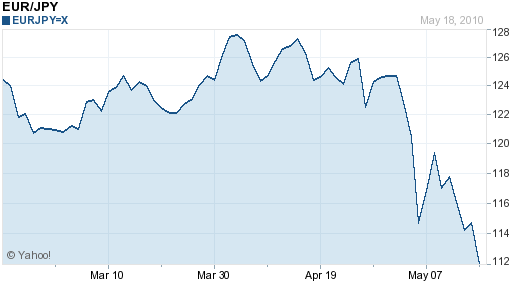
On the surface, the Japanese Yen would seem to be an excellent candidate for shorting, especially in the context of the the Greek fiscal crisis. Its fiscal and economic fundamentals are abysmal, and by most measures, it’s debt position is among the least sustainable in the world, behind even Spain, Portugal, and the US. At the same time, the Yen has risen by an unbelievable 8% against the Euro in the last week alone, and many analysts are predicting it will emerge as one of the winners of this episode.

Euro Yen
Why? First of all, with confidence in the Euro flagging, the Yen (and the Dollar) gain luster as the only viable reserve currencies. Regardless of what you think about Japan’s fiscal fundamentals, the longevity at the Yen means that it is inherently safer than the Euro, which may not even exist (in its current form, at least) in a few years time. Second, the current consensus is that the Euro bailout will fail, and as a result, risk tolerance is running low at the moment. With this in mind, it’s no surprise that traders are unwinding their carry trades and that the Yen â€" “The low-yielding currency of a deflation-prone economy of high savers…entrenched as the world’s funding currency” â€" has rallied.

Analysts have been quick to point out that the rest of Asia (among other regions) are on the other side of this trend. The concern is that the bailout won’t be enough to prevent a repeat credit crunch and that confidence in investments/currencies that are perceived as risky will remain low.

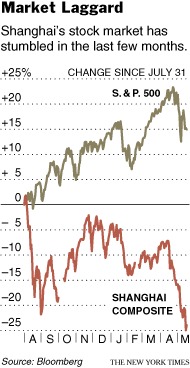
China could be hit especially hard. Since the Chinese Yuan is pegged to the Dollar (and even it wasn’t), it has risen by a whopping 15% against the EUro over the last six months, severely crimping exports to the EU. In addition, “Chinese exporters rely very heavily on bank letters of credit to finance their shipments…When banks have trouble borrowing money themselves â€" as has been happening as a result of worries about European banks’ possible losses from the region’s sovereign debt crisis â€" they tend to cut sharply the issuance of letters of credit for trade finance.” It’s no wonder that the Chinese stock market has tanked 21% so far in 2010, and that the Central Bank continues to delay revaluing the RMB.

Chinese stocks versus S&P
Of course, if the plan turns out to be a success, than the opposite will probably obtain. “In this case…the currency of any emerging market or advanced economy exposed to the Asian region’s impressive, China-led economic growth,” will probably rally. “It could be the South Korean won, the Australian dollar, or the currencies of commodity-producing countries like Brazil.” The Japanese Yen, meanwhile, will probably be hit with a dose of reality, followed by a double dose of the carry trade.

SocialTwist Tell-a-Friend

Powered by WizardRSS | Full Text RSS Feeds

Possible Intervention?

« The Great Unwind! | Home

By Mike Conlon | May 21, 2010

Talk is heating up around the globe that Central Bank interventions could be forthcoming in order to stabilize the currency markets.  Currently, the Swiss National Bank (SNB) has been active in trying to maintain prices for the Franc vs. the Euro, and now the market is jittery that a meeting today of Euro zone finance ministers could produce a similar result.  In addition, the BOJ has been known to intervene in its currency in the past, and there is speculation that Australia may be set to intervene as well.

This is effectively a form of market manipulation, but can be very profitable for investors who are on the right side of the trade.  In this regard, should interventions occur, investors would want to be long the Euro and Aussie, and short the Yen and Swiss franc.  Intervention is already occurring in Switzerland so this trade may be over, but what is important to know is which way policy makers want the currency in question to go.

In addition, German law-makers in the lower house have approved the Euro rescue package, as it is also in Germany’s self-interest to make sure that the Euro doesn’t collapse.

So what we’re seeing this morning is continued short-covering from yesterday afternoon and speculators starting to dip their toes back in cautiously to riskier assets.  Traders do not want to be caught short over the weekend, especially if coordinated action is taken.

In the forex market:

Aussie (AUD):  The Aussie is higher on short covering after aggressively declining for 5 days in a row.  Speculation of possible intervention has led the market to cover their short trades, so don’t mistake today’s action for risk-taking, though early investors may be starting to test the waters to the long side.

Loonie (CAD):  The Loonie is higher this morning as retail sales figures rose the fastest in nearly 5 years, and CPI figures came in slightly higher than expected, showing signs that economic growth is heating up in Canada.  While a June rate hike is still expected for June, much of it will be predicated upon whether or not the Euro can stabilize and whether risk has been reduced in the market.

Kiwi (NZD):  Consumer confidence rose 3.4% in NZ, showing signs of economic life in the country.  In addition, income tax cuts are expected to encourage workers to stay home which will be positive for domestic economic growth.  The Kiwi is higher on short-covering as well.

Euro (EUR):   The Euro touched one-week highs in the overnight session, as German law-makers approved the Euro rescue plan.  The looming threat of intervention has helped push it higher as traders don’t want to be trapped short over the weekend.  In addition, German GDP figures came in as expected, showing a gain of .2% for Q1 after being flat the previous quarter.

Pound (GBP):  The pound is also higher as it has been beaten up with the Euro over the last few sessions.  Expect the Pound to trade somewhat sideways as investors weigh UK policy vs. the threat of continued Euro problems.

Dollar (USD):   The Dollar is weaker this morning as short-covering is taking place.  Expect the Dollar to continue to trade on risk themes, though note that today is not a risk-taking day as both commodities and US stock futures are lower so far this morning.  Global austerity measures could affect US stock growth as demand wanes world-wide.  Especially with blue-chip and technology companies that have large exposure to the EU.  In addition, financial reform bills passed in Congress are adding fuel to the fire.

Yen (JPY):   The Yen is trading lower on short-covering rallies as well, and overnight, the BOJ left rates unchanged at .1%.  In what I would consider as something of an anomaly, the Yen is trading higher against the Dollar further illustrating that this is not a pure risk-taking day.  While the Yen is still far away from levels that the BOJ would consider in order to intervene, they have been known to act in the past.

Because today is a Friday, the market is taking a respite as fear has ruled this week and the potential for central bank interventions have caused uncertainty.  Right now we are at an inflection point; where markets could go one way or another and which way that will be is anyone’s guess.

So in the meantime, I advise taking cues from the market and take profits if you have them, and wait for next week’s action to initiate new trades.  More than one trader has “blown up” by coming in Monday morning to a bit of nastiness in the form of central bank intervention.  And while it is unlikely that this will happen, the threat is enough to cause caution.

To learn more about how you can take advantage of world events through the currency market, be sure to check out our currency trading courses!

To follow these events live with a free, real-time practice account, click here!  Don’t miss out on the world’s fastest growing market!


Tags: account, AUD, Aussie, Australia, bank, cad, canada, central bank, commodities, course, currenc, currency, currency market, currency trading, dollar, economic, EUR, Euro, fear, financial, forex, forex market, franc, free, fx, fxedu, gbp, home, Il, interest, intervene, intervention, invest, investor, jpy, Kiwi, life, live, loonie, lower, meeting, Mike Conlon, nzd, pound, practice, practice account, rate, retail sales, short, ssi, stock, Swiss, Switzerland, time, trade, trader, trades, USD, Yen

Topics: What To Look At In The Market |

Comments

Powered by WizardRSS | Full Text RSS Feeds

Friday, June 27, 2008

Forex Glossary W

Forex Glossary W

Wedge Chart Pattern – Chart formation that shows a narrowing price range over time, where price highs in an ascending wedge are incrementally less, or in a descending wedge, price declines are incrementally smaller. Ascending wedges typically conclude with a downside breakout, and descending wedges typically terminate with upside breakouts.

Whipsaw - slang for a condition of a highly volatile market where a sharp price movement is quickly followed by a sharp reversal.

Wholesale Prices – Measures the changes in prices paid by retailers for finished goods. Inflationary pressures typically show up here earlier than the headline retail.

>> Back to Forex Glossary

Forex Glossary D

Forex Glossary D

Day Trader - Speculators who take positions in commodities which are then liquidated prior to the close of the same trading day.

Dealer - An individual or firm that acts as a principal or counterpart to a transaction. Principals take one side of a position, hoping to earn a spread (profit) by closing out the position in a subsequent trade with another party. In contrast, a broker is an individual or firm that acts as an intermediary, putting together buyers and sellers for a fee or commission.

Deficit - A negative balance of trade or payments.

Delivery - An FX trade where both sides make and take actual delivery of the currencies traded.

Department of Communities and Local Government (DCLG) UK House Prices – A monthly survey produced by the DCLG that uses a very large sample of all completed house sales to measure the price trends in the UK real estate market.

Depreciation - A fall in the value of a currency due to market forces.

Derivative - A contract that changes in value in relation to the price movements of a related or underlying security, future or other physical instrument. An Option is the most common derivative instrument.

Devaluation - The deliberate downward adjustment of a currency's price, normally by official announcement.

Discount Rate – Interest rate that an eligible depository institution is charged to borrow short-term funds directly from the Federal Reserve Bank.

>> Back to Forex Glossary

Forex Glossary

Forex, or FX, stands for the foreign exchange market. This is a 24-hour market in which currencies are traded in cash, which is known as a spot market. There is no central, standard trading center, such as, a stock exchange. Instead, trade is conducted "over-the-counter" via an international network of dealers. Until recently, the forex market was confined to larger traders: major, international commercial and investment banks; international corporations; international money brokers; currency traders. When the United States went off the gold standard in 1971, investors immediately recognized new opportunities for making profits.

forex news

Every year, more companies start up that cater to smaller institutions and investors so they may participate in spot forex trading. A prime factor to take into account before participating in the spot market is your temperament. A risk-aversive customer is not suitable for this marketplace. You should consider not only your experience in the investment world, but your objectives, and your capacity to absorb financial losses. Certainly, you should never invest any amount of money you cannot afford to lose.

Below is some of the important forex terms and there definitions that will help you to understand the forex terms more intelligently and use them accordingly.